Wednesday, September 5, 2012

Review of 'Second Chance: The Story of a Father's Faith, a Mother's Strength, and a Child's Will to Live'

Second Chance: The Story of a Father's Faith, a Mother's Strength, and a Child's Will to Live by Kip Moore is a heart-wrenching story of one family's struggle with E.coli illness in their young eighteen-month-old son, named Chance. Mr. Moore has chosen to share their story, in the hopes of promoting awareness of the problem, and to help families in similar situations to keep the faith.

It all started when the Moore family was on vacation, spending a day at Mount Rushmore. After a random TV interview at the historic site, they decide to go to a local restaurant.

Soon after, Kip found himself feeling quite ill, with flu-like symptoms, lack of appetite, and diarrhea that lasted for ten days. His doctors told him he probably had a small case of food poisoning. Chance became ill the same evening, vomiting repeatedly. The next day, he began to have massive amounts of diarrhea, and even started to pass bloody stools.

The first trip to the pediatrician simply gave Chance some fluids to rehydrate him. When symptoms didn't improve the next day, the Moore family was instructed to take him directly to the Children's Hospital. And thus began a month-long roller coaster ride.

Tense moments, close calls, amazing people, and medical miracles fill the following 100+ pages. Even those who do not have their own children cannot help but feel the pain of a family waiting with baited breath to see if their precious baby is going to live or die. Their unwavering faith and devotion to each other, as well as reengaging with a higher power is inspirational.

This is a book that parents should read, especially as problems with E.coli and other forms of contamination are running rampant today. Chance's parents were not educated on the symptoms of E.coli infection and the outcome could have been quite different. The book also teaches parents how to find faith and to believe in miracles, while also fighting for the rights of their children. No one knows a child better than his parents, and parents need to be their child's biggest advocate.

The book also provides up-to-date information about E.coli, with links to the latest research and organizations. Again, the goal of the book is to arm readers with information, in the hopes that other families don't have to go through the same horror story that the Moore family faced back in the summer of 2005.

I received a complimentary copy of this book in exchange for my honest review.


Monday, September 3, 2012

'Launch Your Child for School Success' - Guest Article by Ann K. Dolin

Ann K. Dolin is the author of the book Homework Made Simple: Tips, Tools and Solutions for Stress-Free Homework. In this guest article, she provides tips for parents, just in time for back to school.


Launch Your Child for School Success
by Ann K. Dolin, M.Ed.

Michael is a freckle-faced fourth grader always on the move. He loves to read, write and do well in class, so his mom was surprised when Michael's teacher reported that he was not handing in his daily homework. She certainly checked every night to make sure it was done.

A visit to the family's home after school one day revealed the source of Michael's problem. School papers from all three of her high-energy children were strewn randomly throughout the house. One backpack was in the hallway, another was on the dining room table and a third was on the kitchen floor. Mom said getting all three kids out the door on time with everything they needed for the school was a challenge. It was apparent that no matter how many times she reminded Michael to pick up his things and get ready for school, he was leaving home without his homework in his backpack.

I suggested Mom try a simple yet powerful solution: the “launching pad”, an approach that helps ensure that children go to school equipped with all their things -- backpack, lunch box, library books, etc. A “launching pad” can be a box, large basket, dishpan or any container big enough to house your child's school items. Put it in a well-traveled area, preferably near the door your child exits and enters going to and from school.

All school-related items should be expected to stay in the “launching pad” when not otherwise in use. Stray school papers or notebooks should be placed it in the bin by other family members who find them lying around. Permission slips and weekly folders signed by a parent should also be placed there. Michael also agreed to place his homework that needed to be in his backpack in the “launching pad” by a certain time, such as 8 p.m., each evening. By instituting this routine, Michael would have his completed work and all necessary materials to take back to school each day. Mornings will become less stressful and school-related clutter will be greatly reduced.

Mom followed my suggestion and put a “launching pad” near the side door that Michael uses. She later reported that it worked so well that all three children now have labeled bins side-by-side.

The “launching pad” is one of several simple strategies parents can use to help their children study better at home. Setting up a designated area for each child for homework is also important. Try and make sure it is relatively free of distractions. Agree with your child on one or two potential study areas.

It’s also crucial to gather school supplies into one central location so that time is not wasted searching here, there and everywhere for pens, pencils, or paper. Label a shoebox with the child's name, or better yet, purchase a shower caddy or tackle box. If the homework location must change for a night or two, this ensures that supplies are portable. Each student will have supplies specific to his grade level, but basics include: lined paper, a calculator, pencils, erasable pens, highlighters and a ruler. Many students also like having a hand-held electronic spell checker at their fingertips. The Franklin Ace is a great tool to help kids check their own work without having to ask you the correct spelling of each word.

The best routines and systems are neither complex nor arduous. By implementing simple easy-to-use strategies you'll help your child along the road to academic success.

###

Ann K. Dolin, M.Ed., is the founder and president of Educational Connections, Inc., a comprehensive provider of educational services in Fairfax, VA and Bethesda, MD. In her new book, Homework Made Simple: Tips, Tools and Solutions for Stress-Free Homework, Dolin offers proven solutions to help the six key types of students who struggle with homework. Numerous examples and easy-to-implement, fun tips will help make homework less of a chore for the whole family. Learn more at anndolin.com or ectutoring.com.

Wednesday, August 29, 2012

'Connecting to the Power of Nature' Book Review

Nature has long been known to have a calming effect on the human psyche. But in this day and age of technology and constant movement, we have forgotten what it is like to go outside and relax. Joe H. Slate, Ph.D. aims to help us reconnect with ourselves by Connecting to the Power of Nature.

Throughout his book, he shares anecdotes about the power of various aspects of nature, such as stars, trees, stones, and more. Many of the experiences are his own, but he also shares those of people he has met throughout his life and work. He then outlines a plan of action to connect to the power of each natural object. These plans tend to consist of six steps, including choosing the item, stating your goal, connecting with the object, affirming your goal, and concluding the exercise to cement it into being.

This may sound like a bunch of New Age hocus-pocus to some people. And in some ways, I can agree with that. But, haven't you ever sat outside on a clear starry night, staring up at the sky, and felt a sense of wonderment and empowerment? Haven't you ever played with sand on the beach, mindlessly letting it fall through your fingers, and feel all of your cares melt away with the dirt? The exercises in this book are essentially the same thing. There are just fancier words and phrases used to explain them all.

No one says that you have to perform all of the exercises within the book, either. Perhaps you have an affinity for trees, but not so much for stones. So, use the tree and leaf exercises. Live close to the beach? Use the sand and water exercises. Meditation and goal setting cannot work if you are not comfortable with your muse of choice.

Also included in the book is a seven day Discovery and Empowerment plan. Each day you connect with a different piece of nature: leaf, cloud, sand, pebble, seed. Then you get in touch with your universal consciousness.

He also includes an appendix with a brief introduction to numerology, to assist you on your journey.

Exercises within this book can be easily adapted for use within families or the workplace, as each group works toward a communal goal of success and peace. Again, pick and choose what works for you within your given situation. And keep an open mind as you reengage with that foreign world known as the Outside.

I received a complimentary copy of this book from the publisher in exchange for my honest review.

Purchase in paperback.


Purchase for Kindle

Monday, August 27, 2012

'Helicopter Parents Raise Kids Who Cannot Fly Alone' Article by Mary Jo Rapini

Helicopter parenting is one of the new trends in parenting techniques. Does this method really work to empower children? Psychotherapist and coauthor of the book Start Talking: A Girl's Guide for You and Your Mom about Health, Sex, or Whatever weighs in on the issue.

Helicopter Parents Raise Kids Who Cannot Fly Alone

by Mary Jo Rapini, MEd, LPC


I was reading a recent article on the subject of "helicopter parenting" and how cell phones and the internet have changed parents' ability to hover over their children. The parents that supposedly hover the most are moms and dads of the "Millennials;" children of baby boomers, born between the early 1980s and 2000. As I read it, I could not help but think of my own childhood. I was the sixth of nine kids and I can safely say my parents most likely didn't know where I was 70% of the time. It wasn't that long ago, and I was raised in a small town, prior to cell phones, internet, and the idea that something catastrophic could happen to me if my parents lost sight of me.

My parents weren't neglectful any more than my neighbors and friends parents. We didn't have the technology and we also didn't have the angst that comes with the technology.  There wasn't the feeling that if I wasn't constantly busy with piano, soccer or tutoring I would fall behind. My parents saw their role as providing a secure home life, plenty of sleep, good food, and help with homework.
Times have changed. Parents talk to their child every day via texts, emails, Facebook, and web sites. Even when the child goes to college mom and dad are still instrumental in guiding their courses, career, and social life. The kids cannot escape and what's more is many of them don't want to. Colleges hire additional staff to answer parents' phone calls and emails just as summer camps do.  Research supports that when parents become involved in their children's activities the children do better. They seem to enjoy the activity more whether it is college or an after school event, but there is a fine line, and the positive effects diminish when parents take over and try to control the activity the child is in.

Being there as a guide to support your child may be helpful, but if your guidance becomes you telling your child what to do, think and how to respond, your child begins feeling incompetent to handle the situations they are involved with. Soon, your child cannot make a decision without asking mom or dad.
From the time your child is born there is a process of learning to let go of them. The key to being a fantastic parent is watching your child and understanding when and how much to let go. Just as children have developmental milestones to attain, parents do too.  Hanging on too tightly to your child begins to produce several of these behaviors listed below:
1. Your child becomes less confident in their own ability to take care of themselves in situations at school or play.

2. Your child becomes fearful and withdraws from novel activities.

3. Your child will develop more anxieties and school phobias may develop.

4. Your child may become less interested in things around them unless you take an interest. A parent should be supportive of a child's interest, but not responsible for it.

5. Parents who are over protective actually suffer more from sadness and poor self image. When you have all of your needs invested in your child to be a success there is little left for you.
It is scary being a parent. We hear stories of abductions, kids getting harmed physically and sexually, and we feel a need to protect our children. If you feel you hold on too tightly though, or if your child seems embarrassed by your unwanted overprotection, there is a way you can loosen your grip without putting your child at risk. Rather than thinking about protecting your child think about empowering them. This will help you raise confident children while allowing you to be engaged:

1. When your child is small you can allow them more freedom to explore, climb and be independent if you provide a safe environment. Look over the playground or park in advance, and find the park that provides security from traffic, while still offering a fun atmosphere for your child to experience.

2. Make mistakes a good thing to experience. Kids who grow up anticipating mistakes take more risks, are less fearful and feel more confident about themselves. We all make mistakes; children have so much to learn in a relatively short period of time. Make sure they can experience their mistakes while being protected in their family. The outside world will never be as forgiving as your own family.

3. If you have a lot of fears from the way you were raised in your family of origin, make sure you deal with those with professional help. Fears are given/taught to children. This is demonstrated by children being terrified of people, things, or events with which they have no experience. The parents often instilled leftover unresolved fears of their past. Being afraid of life and all it has to offer is something you do not want to pass on to future generations.
No one will ever love your child the way you will. Protect their childhood, love them, and offer them new experiences so they can grow and learn. When a child tries something new, it is clear that they look at the new adventure and look back at you. If they see a loving parent who embraces the new while having confidence in their child's ability to master it, they will be empowered to soar.
Mary Jo Rapini, MEd, LPC, is a licensed psychotherapist and co-author with Janine J. Sherman, of Start Talking: A Girl's Guide for You and Your Mom About Health, Sex or Whatever. Read more about the book at www.StartTalkingBook.com and more about Rapini at www.maryjorapini.com.


Wednesday, August 22, 2012

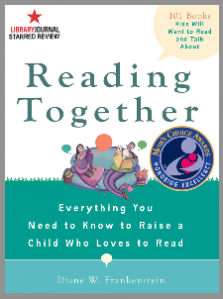
'Reading Together: Everything You Need to Know to Raise a Child Who Loves to Read' Book Review

One of the most important things that parents can do for their children is to establish a love for reading from the very beginning. Reading Together: Everything You Need to Know to Raise a Child Who Loves to Read by Diane W. Frankenstein is a great foundational point for this.

In the introduction to this book, Diane outlines ways for parents to help their children find appropriate books to read, to turn them on to reading. Many times, the child's lack of desire to read simply stems from an inability to find anything that really turns them on and encourages them to keep on reading. She encourages rereading stories, focusing on the plotlines instead of only vocabulary, and performing conversational reading.

Conversational reading is the art of reading a book together and talking about it. Start by asking concrete questions about what happened within the story. Then, find ways to apply the book to the child's personal circumstances, so that he can really put himself into it. Encourage the child to think about other perspectives of the story. The possibilities are endless!

The first part of the book consists of 101 different books that parents and teachers can share with children. Within this part are three different sections. One is for picture books, one for grades 2-5, and those for grades 4-6+. Each book has a short story synopsis, key words, and sample questions that can be used to elicit conversation with the child. Then, there are recommended follow-up titles, if this one was of particular interest to the child.

Part two gets into subject questions, which are even more ways adults can deepen the conversation with the child. Instead of focusing on a particular book, these parts focus on general topics, such as popularity, bullies, manners, choices, and challenges.

Finally, Diane provides even more recommendations for books. Trying to choose only 101 when there are so many good books out there is a daunting task, indeed!

I received a complimentary copy of this book from the author in exchange for my honest review.

Purchase in paperback.


Purchase for Kindle.

Monday, August 20, 2012

Sizzling Summer Reads Giveaway August 20 - September 2

Sizzling Summer Reads

Welcome to the Sizzling Summer Reads hosted by Literary Addicts. This Event takes place August 20 - Sept 2

Each blog participating will have a book related giveaway worth at least $10.
 
The Literary Addicts is also hosting a grand prize - Open Internationally!
 

School is just around the corner. Keeping that in mind, I am teaming up with Literary Addicts as a part of their Sizzling Summer Reads Giveaway. Books for Parents & Teachers is giving away a $10 Amazon gift card. Use it to buy a new resource book for your classroom or something to help you relax after a long day at work.

Because it is a gift card, the contest is open worldwide. The contest runs from August 20th through September 2nd.

a Rafflecopter giveaway

Follow the linky below and hop around!


'Childhood Obesity Intervention - Good or Bad?' Article by Mary Jo Rapini

Earlier this year, the state of Ohio made headlines when it removed a morbidly obese child from his home and placed him into foster care. Psychotherapist and coauthor of Start Talking: A Girl's Guide for You and Your Mom about Health, Sex, or Whatever, Mary Jo Rapini, shares her insights on the obesity epidemic.

Childhood Obesity Intervention-
Good or Bad
?

by Mary Jo Rapini, MEd, LPC
I was asked recently to be an expert for an HLN story involving an 8 year old boy in Ohio. This boy is morbidly obese tipping the scales at 218 pounds. The Department of Children and Family Services (DCFS) took the boy into foster care after they felt the mother was unable to follow through with appropriate measures prescribed for the boy to lose weight.

The mother's defense was that she was going to school in addition to working as an elementary teacher. She felt that she could not monitor the child at all times. Apparently family members and friends were sneaking food to the boy. DCFS reported that they had worked with mom for a year and saw no improvement.

The Ohio State Health Department estimates that more than 12 percent of third graders statewide (Ohio) are severely obese. That could mean as many as 1,380 kids in Cuyahoga County alone. This story is the first time anyone could recall a child being taken from a parent strictly due to weight-related issues.
To consider the idea that the state can handle this issue by removing an obese child from the home and placing him in foster care is not only absurd but dangerous to the development of children. Most likely there will not be enough foster homes and even if there were, will the parents in those homes be able to handle the issues an obese child struggles with? According to recent polls, one out of every three children is morbidly obese. This is not a child crisis; instead, this is a family crisis. In this situation, the child suffered from sleep apnea which meant he was hooked up to a machine at night which monitors and assists his breathing. Many obese children suffer asthma, diabetes, heart disease, hypertension, anxiety, and depression.
Obesity certainly has genetic components but to simply throw your hands in the air with complete surrender to fate is not being a responsible parent. Taking a child away from the family he knows and loves borders on cruelty. Removal of a child from his/her home should only be done as a last resort to protect that child from imminent harm (the child in this case had no other medical conditions except for sleep apnea). Many times removing a child from their home is experienced so intensely by the child that they would resort to food even more as the only thing they could control. Depression, anxiety, and a heightened loss of self-esteem may be the result.

What are we telling a child if we allow them to be taken from us, because we were not able to change our lives enough to help him? I make it clear to all of the parents I work with that if you have a morbidly obese child it takes a family to support them with a healthy lifestyle. There can be no enablers and "good guys" or "bad guys" with offering the child unhealthy foods or a lifestyle conducive to obesity.
If you have a child you are concerned with who struggles with obesity, you have more power within your family than any treatment facility known. The problem is that, many times, you know your child is hurting and that breaks your heart. The guilt you feel from that affects your ability to hold the firm and loving boundaries that your child needs. These suggestions will help you get started.

1. Talk to your pediatrician and tell them your concerns. Make a list of everything you have tried and go over this with your doctor. Don't let your doctor make light of your concerns. No one knows your child as well as you.

2. Have a family meeting and rather than addressing any one child, address the whole family. Become a united team with everyone participating in a healthy lifestyle. Identify the foods that are the most problematic (soda, chips, candy, and pastries) and replace those with raw fruits and vegetables. Make these food visible, keep a basket of raw fruit on the kitchen counter, bottled water in the fridge (or fresh water in pitchers stored in the refrigerator) and vegetables peeled and ready to eat in the refrigerator. The best way to get rid of the junk food is to throw it away. It's toxic! Why would you donate or give someone else what is poisonous to their body?
3. Quit telling yourself that in order for your kids to fit in they need junk food in the house. They don't. This thinking is keeping you from being an effective parent in helping your obese child. It is not fair to let the thin sibling eat junk food and not allow it for the child with weight issues. This builds resentment. Get rid of the junk food and make it forbidden for your whole family.

4. Family activities are helpful for all families as well as marriages. Protect and prioritize these types of days. Take a family walk, go to the park, or (in the winter) ice skating. Anything where there is movement will help everyone be healthier. Activities shared as a family help the child who is overweight feel less isolated and alone.
5. If you are unsure of foods and what to serve, a wise investment is to talk to a dietitian. Many physician offices have dietitians on staff. Getting advice and attaining more knowledge of foods can help you help your child.

6. If your obese child suffers from social anxiety or depression, seek help from a counselor. It is much wiser to begin counseling before your child's self-esteem is destroyed. Rebuilding an obese child's self esteem is much more difficult then learning healthy coping mechanisms that can comfort them so they won't resort to using food.
Child protective services have a huge job and they do it well. There are so many children that need to be placed with foster parents in order to survive. Morbid obesity should not be a reason we need to contact CPS. Parents must get serious with their children's health and well being. Being a parent means taking care of your child and making sure they have all they need to be healthy. If your child is overweight and struggling with health issues, begin making changes to the whole family's lifestyle today.
Mary Jo Rapini, MEd, LPC, is a licensed psychotherapist and co-author with Janine J. Sherman, of Start Talking: A Girl's Guide for You and Your Mom About Health, Sex or Whatever. Read more about the book at www.StartTalkingBook.com and more about Rapini at www.maryjorapini.com.